You are not losing your job to AI. You are losing it to a quiet rewrite of what your job is actually worth.
The loud "AI is coming for your job" headlines miss the real story. The 2025 job market is not about total replacement; it is about a ruthless recalibration of value. Parts of your work are getting cheaper by the week. Other parts are becoming almost impossible to replace.
AI has turned average digital work into a commodity. Writing a generic email, drafting a basic landing page, or summarizing a Zoom call used to be "experience." Now it’s a button. As the price of this work trends toward zero, the market is paying a premium for something else entirely: human judgment, physical dexterity, and complex, messy problem-solving.
This isn’t a horror story. It is a sorting mechanism. And if you understand it early, you can build a career that doesn’t just survive the algorithm, but uses it as leverage.
📉 The "Middle-Skill" Trap Is Real
Start with what is shrinking.
Economists have warned for years about "labor market polarization"—growth at the top and bottom of the market, with the middle squeezed out. AI just hit the fast-forward button.
The roles under the most pressure right now live in the "digital middle." These are entry-level and mid-level knowledge jobs that revolve around processing information instead of creating real insight. According to McKinsey, generative AI could automate 60 to 70 percent of the work activities people spend time on today. Activities—not entire professions.
If your workday is mostly:
- moving data from one system to another,
- summarizing information that already exists, or
- producing content that sounds like everything else on the internet,
You are in the blast radius. The market has already decided: you will not beat machines on speed, memory, or volume. Your only winning play is to move where they are weak—context, consequences, and the physical world.
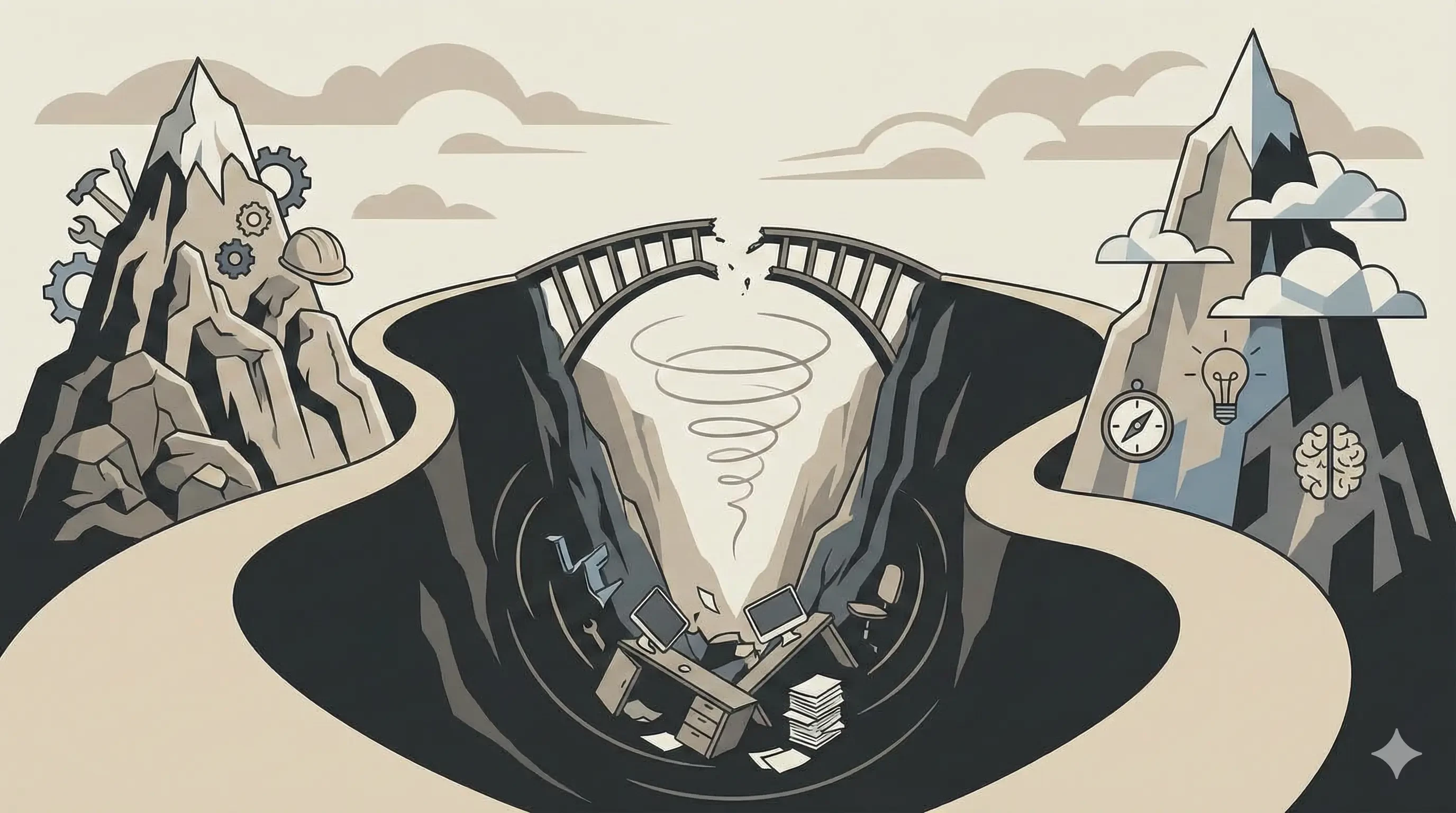
🧠 Value-Building: Moravec's Paradox and Your Paycheck
Here’s the lens that makes all of this click: Moravec’s Paradox.
AI researchers in the 1980s noticed something weird: it is relatively easy to get computers to perform well on IQ-style tests or beat humans at board games, but incredibly hard to give them the everyday physical and perceptual skills of a toddler. In simple terms:
- Hard for AI: Navigating a crowded jobsite, repairing a leaking pipe hidden behind old drywall, reading tension in a client’s voice, diagnosing a weird rattle in a machine in bad weather.
- Easy for AI: Passing standardized exams, drafting boilerplate contracts, rewriting marketing copy in a different tone, analyzing large datasets for patterns.
For years, people were told that "head work" was the safe path and "hand work" was risky. Moravec’s Paradox flips that logic. In an AI-heavy economy, the hardest, most defensible work is often the stuff that requires both a body and a brain operating in chaotic, unstructured environments.
This is why some jobs that looked "less prestigious" a decade ago now have more real security than mid-level office roles with fancy titles.
🛑 The Unpluggable Career: Why Trades Are the New Tech
Because of this shift, there is a visible "flight to reality" in the skilled trades. While parts of the tech and digital sectors are dealing with hiring freezes and restructuring, there is a growing shortage of people who can actually build, maintain, and repair the infrastructure everything else relies on.
The Bureau of Labor Statistics expects many construction and extraction occupations to grow faster than the average for all jobs, powered by aging infrastructure, housing demand, and sustainability-driven retrofits. These roles are not just "jobs"; they are unpluggable careers. You cannot refactor a bridge from inside a data center.
If you want a pivot that offers strong earning potential and insulation from generative AI, look hard at roles that require physical presence plus specialized knowledge: electricians, HVAC technicians, solar installers, industrial mechanics, precision manufacturing, and more. These are not a consolation prize—they are becoming the backbone of the real economy.
We see this shift in real time: interest in these roles is rising as people look for work that cannot be virtualized. If you’re curious what that demand looks like right now, explore active openings on our skilled trades listing page: /jobs/skilled-trades.
⚙️ The "Human-in-the-Loop" Strategy
Not everyone wants to move into physical trades. If you want to stay in the corporate or digital world, you need a different move: becoming the human in the loop, not the human in the way.
AI can generate code, content, and forecasts at scale. What it cannot do is own the consequences. That’s your lane.
Your value is no longer "I can produce X." It becomes "I can make sure X is correct, safe, aligned with reality, and worth doing."
Three durable skills to lean into:
- Complex Communication: AI can generate a script. It struggles to read a room, defuse conflict, or convince a skeptical stakeholder who doesn’t care about your data but cares deeply about risk.
- Strategic Synthesis: AI can hand you fifty plausible options. Someone still has to understand the business, the politics, the constraints, and say, "We’re doing this one—and here’s why."
- Accountability: Models cannot sign contracts, testify in court, or take responsibility when things go sideways. Organizations still need humans who can be answerable for decisions.
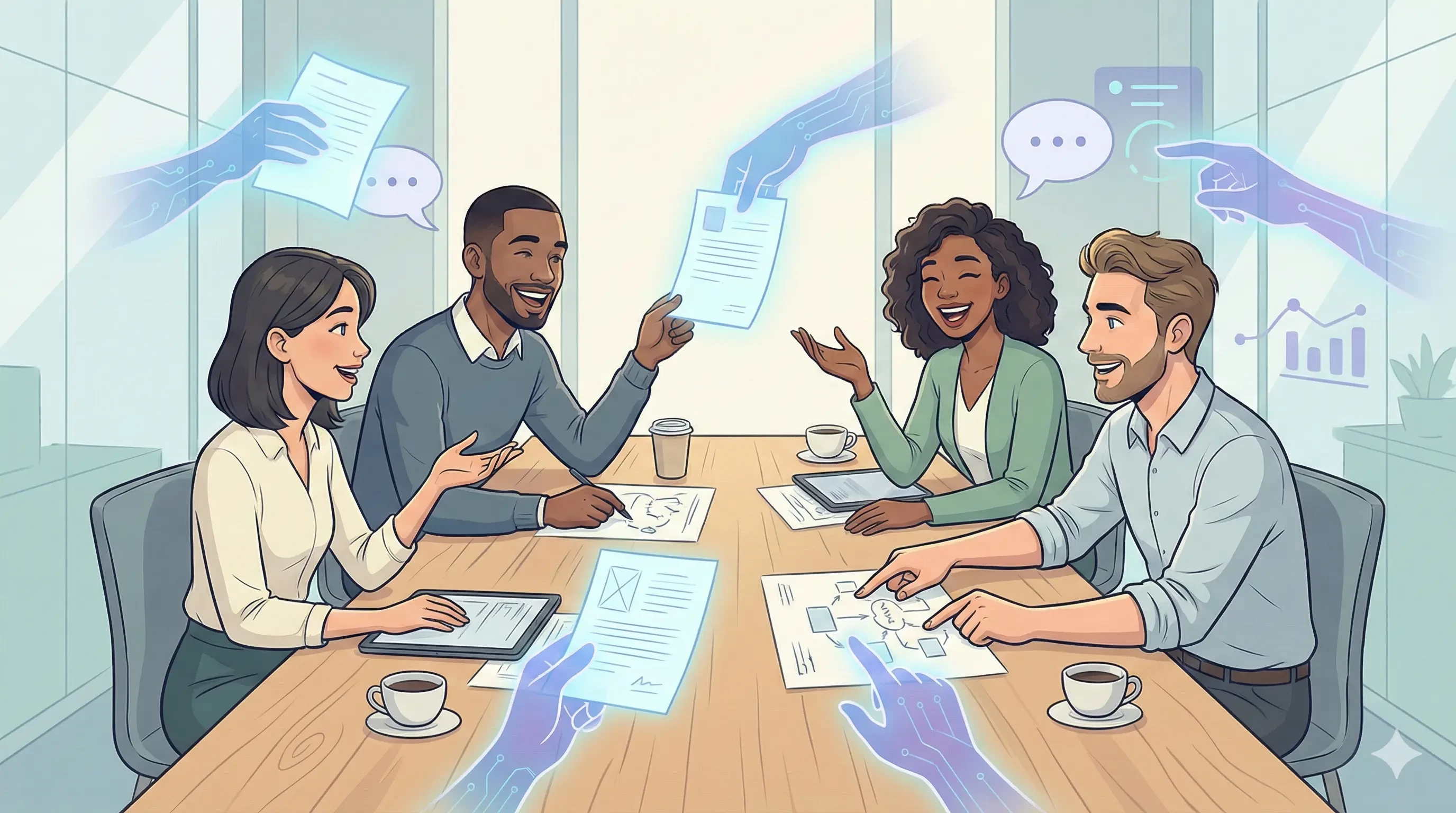
✅ Your Action Plan: 4 Steps to AI-Proof Your Week
Thinking about this is useless if your calendar stays the same. Here’s how to start shifting in the next seven days.
1. Run a "Robot Audit" on Your Tasks
Look back at your last week. List every task that was repetitive, rules-based, or purely digital—something you could describe in a simple "if X, then Y" rule. Assume those tasks will be automated or heavily assisted within 12–24 months. Your move: start using AI tools to handle them now, and deliberately spend more time on the work that requires judgment, negotiation, or dealing with real-world constraints.
2. Move Closer to the Point of Service
Roles that sit far away from the customer or the product are the most exposed. Back-office-only work is shrinking. Look for ways to move closer to where value is created: sales conversations, client delivery, field operations, production, implementation. The closer you are to the moment money changes hands or something real gets built, the harder you are to cut.
3. Build a Hybrid Skill Set
The most resilient professionals are "bilingual": they speak both domain and technology. If you’re in construction, learn the digital tools used for estimating or 3D design. If you’re in healthcare, learn how data flows through the system. If you’re in marketing, understand privacy and attribution. Harvard Business Review calls these "fusion skills"—the blend of human judgment and machine capability that tends to sit on the high end of the pay scale.
4. Embrace the Squiggly Path
The career ladder has been replaced by a career web. Lateral moves that look strange on paper can be incredibly smart in an AI-shaped market. A year in customer support might make you a better product manager. Time on a jobsite might make you a better engineer. The point is not a straight title progression; it’s accumulating context that no model has.
🚀 The Future of Work Is Human-Centric
Here is the ground truth: AI is astonishing at answers, but terrible at questions. It can optimize for a goal, but it cannot decide which goals are worth chasing, or what happens to people if we’re wrong.
The future belongs to people who can do what AI can’t: enter a messy situation—on a construction site, in a factory, in a clinic, in a boardroom—and turn confusion into clarity. It belongs to those who understand both the tools and the stakes.
You don’t have to beat AI. You have to stop trying to be it.
Choose work where your body, your judgment, or your integrity are non-optional. Use the tools where they help. Ignore the headlines designed to scare you. The algorithm is not your competitor; it’s your new environment. Learn it—or move where it can’t go—and you’ll be fine.


